

Updated March 2026 • By Fitness Equipment Experts • 20 min read
| Building a home gym has never been more practical — or more rewarding. The right combination of equipment eliminates gym commutes, removes scheduling barriers, and puts every workout you’ll ever need within arm’s reach. Whether you’re working with a full basement, a spare bedroom, or a single garage corner, these 10 must-haves form the foundation of a truly complete home fitness setup. |
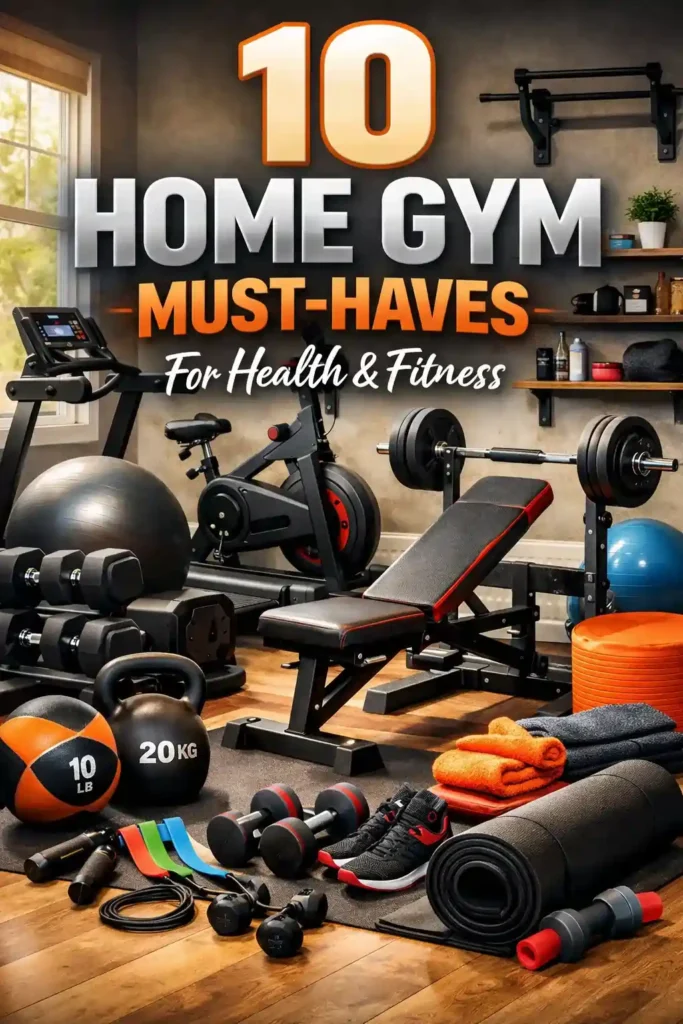
The global home fitness market has changed dramatically since 2020.
Equipment that was once the exclusive domain of commercial gyms — adjustable dumbbell systems, silent magnetic resistance machines, smart fitness trackers — is now accessible, compact, and built specifically for home use.
Today, a thoughtfully equipped home gym can match, and in many respects surpass, what a traditional gym offers.
But with thousands of products competing for your attention and budget, knowing what to prioritize is half the battle. This guide cuts through the noise.
Each item on this list was selected based on three criteria: versatility (how many exercises and muscle groups it serves), durability (how long it lasts under real-world use), and return on investment (the value it delivers relative to its cost over time).
Whether you’re a complete beginner setting up your very first home gym or an intermediate athlete upgrading an existing setup, these 10 pieces of equipment will serve you for years — and deliver results that no commercial gym membership can guarantee.
Quick Reference: All 10 Must-Haves at a Glance
| # | Must-Have | Best For |
| 1 | Adjustable Dumbbells | Strength training, HIIT, full-body workouts |
| 2 | Resistance Bands | Mobility, rehab, warm-ups, portable strength |
| 3 | Power Rack / Squat Stand | Heavy compound lifts, progressive overload |
| 4 | Adjustable Weight Bench | Pressing, rowing, dips, incline/decline work |
| 5 | Cardio Machine (Elliptical) | Low-impact cardio, fat loss, endurance |
| 6 | Pull-Up Bar | Upper-body pulling, core, lat development |
| 7 | Exercise / Yoga Mat | Floor work, stretching, core, yoga, HIIT |
| 8 | Foam Roller | Upper-body pulling, core, and lat development |
| 9 | Kettlebell Set | Ballistic power, functional strength, cardio |
| 10 | Fitness Tracker / Smartwatch | Heart rate, sleep, progress, accountability |
| #1 | Adjustable Dumbbells: The single most versatile strength tool for any home gym |
If you could only choose one piece of strength equipment for your home gym, adjustable dumbbells would win every time.
A quality adjustable dumbbell system replaces an entire commercial rack of fixed-weight dumbbells — typically spanning 5 to 52.5 lbs per hand — in a footprint smaller than a shoebox.
Modern dial-select and pin-select systems allow you to change weight in seconds, making them ideal for circuit training, drop sets, progressive overload programs, and everything in between.
They work for virtually every exercise in the strength training canon: chest presses, bent-over rows, shoulder presses, bicep curls, tricep extensions, goblet squats, Romanian deadlifts, and countless variations.
What to Look For
- Weight range: Aim for 5–52.5 lbs per hand at minimum; serious lifters may want systems reaching 90 lbs
- Adjustment mechanism: Dial systems (like Bowflex SelectTech) are fast; pin systems are more durable under heavy use
- Handle feel: Knurled metal handles provide superior grip over smooth plastic — especially when hands are sweaty
- Selector durability: Read reviews specifically mentioning the selector mechanism; cheap internals break under repeated heavy drops
| Best for | Strength, hypertrophy, HIIT, functional fitness |
| Space required | Minimal — fits on a small shelf or compact tray stand |
| Budget range | $200–$600 for quality adjustable sets |
| Top brands | Bowflex SelectTech, PowerBlock, Nüobell, REP Fitness |
| Muscles worked | Full body — virtually every major muscle group |
| #2 | Resistance Bands: Portable, affordable, and surprisingly powerful |
Resistance bands are the most underrated tool in home fitness. At a fraction of the cost of any weight-based equipment, a quality resistance band kit delivers a genuinely comprehensive strength and mobility workout targeting every major muscle group.
Bands are particularly effective for rehabilitation work, warm-up activation, mobility training, and as a complement to heavy barbell or dumbbell exercises.
The variable resistance profile of bands — increasing tension as the band stretches — mimics the strength curve of many exercises better than fixed weights, providing maximum resistance at the peak contraction point where muscles are mechanically strongest.
A door anchor attachment unlocks an entirely new dimension of band training: cable machine imitations, including chest flyes, seated rows, lat pulldowns, and tricep pushdowns, become possible anywhere in your home with no additional equipment required.
What to Look For
- Band types: Invest in both loop bands (for leg/glute work) and tube bands with handles (for upper-body pulling and pressing)
- Resistance range: A full kit typically includes five resistance levels from light (~10 lbs) to extra-heavy (~50+ lbs)
- Material: Fabric loop bands stay in place better than rubber during leg exercises; latex tube bands offer more stretch for pulling movements
- Door anchor: A high-quality anchor transforms any room into a functional cable station — do not skip this accessory
| Best for | Mobility, rehab, warm-ups, travel workouts, accessory training |
| Space required | Nearly zero — stores in a small bag or drawer |
| Budget range | $20–$80 for a complete kit |
| Top brands | Full body, depending on exercise selection |
| Muscles worked | Full body depending on exercise selection |
| #3 | Power Rack or Squat StandThe cornerstone of serious home strength training |
For anyone serious about building strength through compound movements — squats, bench press, overhead press, deadlifts — a power rack or squat stand is the most important structural investment in your home gym. It is the piece of equipment that makes heavy, safe, unsupervised strength training possible.
A power rack (also called a squat cage) features four upright columns with adjustable safety bars (spotter arms) that catch a failed rep before it injures you.
This means you can push to genuine failure on squats and bench press without a training partner present — a critical advantage for solo home gym training.
Squat stands are a more compact and affordable alternative, typically sacrificing the safety catch system for a smaller footprint.
The attachment ecosystem is equally important: quality racks accept cable attachments, dip handles, landmine bases, plate storage pegs, and more, effectively multiplying the exercise variety of the unit over time.
What to Look For
- Steel gauge: 11-gauge or 12-gauge steel is the standard for home use; thicker (lower gauge number) means more rigidity
- Safety arms: Non-negotiable for solo training; verify they can be adjusted quickly between exercises
- Weight rating: Look for a 1,000+ lb static rating for future-proofing as your strength grows
- Hole spacing: 1-inch Westside spacing in the bench zone enables precise barbell positioning for pressing
| Best for | Squats, bench press, overhead press, pull-ups, barbell rows |
| Space required | Medium to large — 4’×4′ footprint minimum; ceiling height 8’+ |
| Budget range | $400–$900 for quality home power racks |
| Top brands | Titan Fitness T-3, Rogue R-3, REP Fitness PR-4000, Bells of Steel |
| Muscles worked | Full body — the foundation of compound strength programming |
| #4 | Adjustable Weight Bench: Multiplies the value of every other piece of equipment you own |
An adjustable weight bench is a great force multiplier of home gym equipment.
Every dumbbell, barbell, and resistance band exercise that can be performed sitting, lying flat, or at an angle is unlocked by this single piece of furniture.
Without a bench, your home gym is fundamentally limited to standing and floor-based movements only.
The incline, flat, and decline positions of an adjustable bench distribute muscle activation across different segments of the chest, shoulders, and back.
Incline pressing shifts emphasis to the upper chest and anterior deltoids; decline work targets the lower pectorals; flat pressing maximizes mid-chest engagement.
No fixed flat bench, however high-quality, can replicate this range.
Beyond pressing, the adjustable bench supports single-arm rows, step-ups, Bulgarian split squats, hip thrusts, dumbbell pullovers, face pulls, and dozens of accessory movements that are difficult or impossible to perform on the floor.
What to Look For
- Weight capacity: At minimum 600 lbs; 1,000+ lb rated benches are future-proof against increasing loads
- Pad firmness: A pad that is too soft will compress under heavy loads and destabilize your pressing base
- Adjustment range: Look for multiple incline positions between 0° and 85° plus a decline option
- Stability: Wobble is a red flag; test or read reviews specifically addressing lateral stability under load
| Best for | Chest press, shoulder press, rows, incline/decline variations, hip thrusts |
| Space required | Small to medium — foldable models save space when not in use |
| Budget range | $150–$500 for quality adjustable benches |
| Top brands | REP Fitness AB-5200, Rogue Adjustable Bench 2.0, Bowflex 5.1S, FlatHead 4 |
| Muscles worked | Chest, shoulders, triceps, back (depending on exercise) |
| #5 | Cardio Machine (Elliptical, Treadmill, or Bike): Your engine for fat loss, heart health, and endurance |
No home gym is complete without a dedicated cardio machine.
Cardiovascular training improves heart health, accelerates fat loss, enhances recovery between strength sessions, and supports long-term metabolic health in ways that strength training alone cannot replicate.
The question is not whether to invest in a cardio machine — it is which type serves your specific goals and space constraints best.
For most home gym users in 2026, an elliptical trainer represents the strongest all-around choice.
Ellipticals deliver cardiovascular intensity equivalent to running with zero impact stress on the knees, hips, and ankles — making them safe for users with joint concerns, older adults, and anyone in active recovery.
The dual-handlebars also engage the upper body, elevating caloric expenditure beyond what cycling or treadmill walking achieves.
Treadmills are the best choice for runners who want to maintain sport-specific training indoors.
Exercise bikes (upright or spin) are ideal for apartment dwellers who need an ultra-compact, ultra-quiet option.
Rowing machines provide the most complete full-body cardiovascular workout of any machine — engaging 86% of the body’s muscles per stroke.
What to Look For
- Drive/resistance type: Magnetic resistance for ellipticals and bikes — silent, maintenance-free, and consistent
- Stride or deck size: 16″+ stride for ellipticals; 18″+ belt width for treadmills
- Connected fitness: Free platforms (like SunnyFit) offer better lifetime value than expensive monthly subscriptions
- Noise level: Belt-drive or magnetic resistance machines are apartment-safe; chain or friction systems are not
| Best for | Cardiovascular health, fat loss, endurance, and active recovery |
| Space required | Medium — compact ellipticals and folding treadmills work in tight spaces |
| Budget range | $300–$2,500 depending on type and features |
| Top options | Sunny SF-E323038 elliptical, Sole F85 treadmill, Concept2 RowErg, Schwinn IC4 bike |
| Muscles worked | Lower body primary; full body depending on machine type |
| #6 | Pull-Up Bar: The most cost-effective upper-body tool in existence |
The pull-up bar is perhaps the highest-value-per-dollar item in this entire list. For $30–$150, you gain access to one of the most effective upper-body exercises ever documented — one that builds the latissimus dorsi, biceps, rear deltoids, rhomboids, and core simultaneously, with a depth and intensity that most cable machines cannot replicate.
Doorframe pull-up bars are the most space-efficient option — they mount without drilling, fit any standard doorframe, and can be stowed away in seconds.
Wall-mounted or ceiling-mounted bars offer greater stability for kipping movements, weighted pull-ups, and gymnastic ring work.
Power rack-mounted pull-up bars combine both functions if you already have a rack.
The pull-up bar also enables additional exercises beyond the standard movement: hanging knee raises and leg raises for core work, Australian rows for horizontal pulling (with a lower bar), inverted rows with a straight bar grip, and L-sit holds for isometric core and shoulder strength.
Variations to Consider
- Doorframe bars: Affordable, tool-free installation, portable — best for beginners and apartment users
- Wall-mounted bars: Stable enough for weighted work and kipping movements; requires drilling
- Freestanding towers: Include dip stations and push-up handles — a complete bodyweight gym in one unit
- Gymnastic rings: The most challenging upper-body bodyweight tool; pairs with any pull-up bar mount
| Best for | Lat development, upper-body pulling strength, core, bodyweight training |
| Space required | Virtually zero (doorframe) to minimal (wall-mount) |
| Budget range | $30–$150 |
| Top brands | Iron Gym, Rogue, Rep Fitness, Titan Fitness, Doorway-series options |
| Muscles worked | Lats, biceps, rear delts, rhomboids, core stabilizers |
| #7 | Exercise Mat / Yoga Mat: The foundation of every floor-based workout |
The exercise mat is perhaps the least glamorous item on this list and one of the most consistently underestimated.
A high-quality mat transforms any hard floor surface — concrete, hardwood, tile — into a safe, cushioned training environment for floor-based work.
Without it, exercises like push-ups, planks, mountain climbers, burpees, core work, and yoga become uncomfortable at best and injury-prone at worst.
Thickness matters significantly: standard yoga mats at 3–6mm work well for balance and yoga practice, while exercise and fitness mats at 10–20mm provide the cushioning necessary for high-intensity floor training, plyometrics, and recovery stretching. For a home gym, a 10–15mm high-density foam mat strikes the best balance between cushioning and stability.
For heavy weightlifting areas, interlocking rubber floor tiles (typically 3/8″ or 3/4″ thick) are the appropriate solution — they protect your concrete or wood floor from dropped weights, reduce noise transmission, and provide non-slip grip during loaded movements. These are a separate consideration from exercise mats, but equally important for complete home gym flooring.
What to Look For
- Density: High-density foam provides both cushioning and stability; low-density foam compresses under load and loses support quickly
- Non-slip surface: Both the top and bottom surfaces should grip firmly — critical for yoga balance poses and explosive movements
- Size: Aim for a mat at least 72″ long and 24″ wide; 80″+ length accommodates taller users and lying stretches
- Moisture resistance: Closed-cell foam resists sweat absorption; open-cell foam requires more maintenance
| Best for | Floor exercises, core work, yoga, stretching, HIIT, recovery |
| Space required | Rolls up for storage — negligible footprint |
| Budget range | $25–$120 for quality exercise mats |
| Top brands | Liforme, Manduka PRO, Retrospec, Lululemon, BalanceFrom |
| Muscles worked | All — the mat supports training for every muscle group |
| #8 | Foam Roller: Recovery is training — and this is the tool that makes it possible |
Recovery is not the absence of training — it is an active component of the training process. The foam roller is the primary self-myofascial release (SMR) tool for home gym athletes, delivering many of the same soft-tissue benefits as a professional sports massage at a fraction of the cost.
Rolling out tight muscles before a workout increases blood flow, reduces stiffness, and improves joint range of motion — contributing to better lifting mechanics and reduced injury risk during training.
Post-workout rolling reduces delayed onset muscle soreness (DOMS), breaks up adhesions in fascia and muscle tissue, and accelerates the metabolic clearing of exercise byproducts from worked muscles.
The most commonly targeted areas with a foam roller include the thoracic spine (upper back), IT band and lateral quads, calves and Achilles complex, piriformis and glutes, and lats.
Regular foam rolling practice — even 10 minutes per session — produces measurable improvements in flexibility, mobility, and training readiness over time.
Types of Foam Rollers
- Smooth rollers: Best for beginners or those with sensitive muscle tissue; provide even pressure distribution
- Textured/grid rollers: Deeper tissue penetration for experienced users; replicate a therapist’s fingertip pressure
- Vibrating rollers (powered): Battery-powered vibration accelerates fascia release — the most effective but most expensive option
- Lacrosse ball: A firm rubber ball for precise trigger point work in smaller areas (glutes, feet, shoulders)
| Best for | Myofascial release, recovery, mobility, pre-workout activation |
| Space required | Negligible — stores in a corner or on a shelf |
| Budget range | $20–$50 (manual); $80–$180 (vibrating) |
| Top brands | TriggerPoint GRID, RumbleRoller, Hyperice Vyper, Amazon Basics |
| Muscles targeted | IT band, quads, calves, glutes, lats, thoracic spine |
| #9 | Kettlebell Set: Ballistic power, functional strength, and cardio in one compact tool |
If the dumbbell is the bread-and-butter of strength training, the kettlebell is its more athletic cousin.
The offset center of mass of a kettlebell — with its weight distributed away from the handle — creates rotational forces that demand greater stabilization from the wrist, elbow, shoulder, and core compared to equivalent dumbbell movements.
This makes kettlebells exceptionally effective at building functional strength and athletic power simultaneously.
Kettlebell-specific movements like the swing, clean, snatch, and Turkish get-up develop explosive hip power, posterior chain strength, grip endurance, and cardiovascular conditioning in a single integrated movement.
The kettlebell swing alone — often cited as one of the most effective exercises in existence — trains the glutes, hamstrings, lower back, shoulders, and core in a ballistic hip-hinge pattern that no machine can replicate.
For a home gym, a starter set of three to four kettlebells covering a practical weight range (12kg, 16kg, 20kg, and 24kg for most adults) provides the versatility to train power, strength, and metabolic conditioning without requiring additional equipment.
What to Look For
- Cast iron construction: Single-piece cast iron kettlebells (no welds between handle and bell) are more durable and balanced
- Handle finish: Powder-coated handles offer better bare-hand grip than painted or chrome finishes — important for high-rep work
- Flat base: A flat bottom allows the kettlebell to be stored upright and used as a push-up handle — a useful secondary function
- Weight selection: Women typically start with 8–12kg; men with 12–16kg for beginner movements
| Best for | Power training, metabolic conditioning, functional strength, grip work |
| Space required | Minimal — stacks in a corner or on a compact rack |
| Budget range | $30–$100 per bell; $150–$400 for a starter set |
| Top brands | Rogue, REP Fitness, Kettlebell Kings, Cap Barbell |
| Muscles worked | Full body — posterior chain, core, shoulders, grip |
| #10 | Fitness Tracker / Smartwatch: The data that turns effort into progress |
Every other item on this list creates the environment for fitness to happen. A fitness tracker provides the data to understand whether your efforts are actually producing results.
In 2026, the best fitness wearables have evolved into sophisticated biometric platforms that track heart rate, heart rate variability (HRV), sleep quality, recovery readiness, blood oxygen saturation, stress levels, and GPS-mapped outdoor workouts — all from your wrist.
Heart rate monitoring during cardio training is the most immediately actionable feature: knowing whether you are in Zone 2 (aerobic fat-burning), Zone 3 (tempo training), or Zone 4-5 (lactate threshold and VO2 max territory) allows you to target the correct physiological adaptation for each session. Without this data, cardio training becomes guesswork.
Sleep tracking is the second most valuable feature for home gym athletes. Sleep quality directly governs muscle protein synthesis, hormone production (particularly testosterone and growth hormone), nervous system recovery, and next-day workout performance. Wearables that quantify sleep stages and recovery scores transform sleep from an afterthought into a trainable variable.
What to Look For
- Heart rate accuracy: Optical wrist-based sensors vary significantly in accuracy; paired chest straps provide the most precise data during high-intensity work
- Battery life: Longer battery life (5+ days) reduces charging friction and ensures continuous tracking
- App ecosystem: Deep third-party integration (Garmin Connect, Apple Health, Google Fit, Strava) keeps all your fitness data in one place
- Durability: Water resistance rating of at least 5ATM for sweat and shower resilience
| Best for | Heart rate zones, sleep, recovery, accountability, progress tracking |
| Space required | Zero — worn on the wrist |
| Budget range | $80–$500 depending on feature depth |
| Top brands | Garmin (Forerunner / Fenix series), Apple Watch Series 9, Fitbit Charge 6, WHOOP 4.0 |
| Key metrics | Heart rate, HRV, sleep stages, VO2 max estimate, calories, steps |
Building Your Home Gym: A Phased Approach by Budget
You do not need to acquire all 10 items at once. Building a home gym is best approached in phases, prioritizing the highest-value items first and expanding as your budget and fitness needs grow.
| Phase | Budget | Equipment Priority |
| Phase 1: Foundation | $150–$350 | Resistance bands + exercise mat + pull-up bar + foam roller |
| Phase 2: Strength | $350–$800 | Add adjustable dumbbells + adjustable weight bench |
| Phase 3: Cardio | $300–$600 | Add a quality elliptical or cardio machine |
| Phase 4: Power | $150–$400 | Add kettlebell set + fitness tracker |
| Phase 5: Complete | $500–$1,000 | Add power rack to unlock heavy compound training |
Pro Tips for Setting Up Your Home Gym
Getting the equipment right is only part of the equation. Here are the practical, experience-backed principles that separate successful home gym setups from expensive storage rooms:
- Invest in rubber flooring first: Interlocking rubber floor tiles protect your floor, reduce noise, provide grip, and cushion impact. This is the first investment, even before any equipment purchase.
- Prioritize versatility over specialization: A pair of adjustable dumbbells and a resistance band kit outperform any single-function machine for most home gym users — especially in smaller spaces.
- Buy quality once, not budget twice: Cheap barbells, flimsy benches, and low-gauge power racks fail under load. Premium equipment from established brands costs more upfront and lasts a decade or more.
- Control the environment: Proper lighting, a quality mirror (for form checking), and ventilation significantly impact workout quality and long-term adherence — do not neglect these non-equipment factors.
- Track from day one: A fitness tracker or even a simple training log creates the accountability loop that drives long-term progress. What gets measured gets improved.
Start with what you will actually use: The best home gym equipment is the equipment you’ll use consistently. Match your initial purchases to your current fitness habits, not your aspirational ones.
Frequently Asked Questions
What is the most important piece of home gym equipment for beginners?
Adjustable dumbbells and resistance bands are the two highest-priority items for beginners. Together, they provide everything needed to build foundational strength across all major muscle groups, fit in minimal space, and accommodate progressive overload as fitness improves — all without requiring a large upfront investment or dedicated room.
How much does it cost to build a complete home gym?
A fully functional home gym that includes all 10 items on this list typically costs between $1,500 and $5,000, depending on the brand and quality tier. A practical starter setup — resistance bands, mat, pull-up bar, adjustable dumbbells, and a bench — can be assembled for $400–$700. The phased approach outlined above allows you to build progressively without a single large capital outlay 1.
How much space do I need for a home gym?
A surprisingly small amount of space is sufficient for a highly functional home gym. A 10’×10′ area accommodates adjustable dumbbells, a bench, a pull-up bar, a mat, and resistance band work comfortably. A 10’×15′ space can house all of the above plus a compact cardio machine. A power rack requires at a minimum a 4’×6′ footprint with 8+ foot ceiling clearance.2
Is a home gym worth the investment compared to a gym membership?
For most people who train consistently three or more times per week, a home gym pays for itself within 18–36 months compared to an ongoing gym membership. Beyond the financial break-even, the convenience advantage — no commute, no wait times, no operating hours, complete privacy — delivers lifestyle value that cannot be quantified by cost alone. The real question is not whether a home gym is worth it, but which items to buy first.3
What cardio machine is best for a home gym?
For most home gym users, an elliptical trainer offers the best combination of cardiovascular effectiveness, joint safety, space efficiency, and noise level. Treadmills are best for dedicated runners. Exercise bikes are ideal for ultra-compact spaces or cycling enthusiasts. Rowing machines deliver the most complete full-body cardio workout per session. Your choice should be guided by which machine you are most likely to use consistently.
The Bottom Line
| A great home gym is not built in a day, and it does not require spending thousands of dollars upfront. Start with the basics — bands, a mat, adjustable dumbbells — and build systematically. Each item on this list multiplies the value of what you already have. The best investment you can make in your health and fitness is one you will actually use, consistently, over months and years. |
The 10 must-haves in this guide were chosen because they work — not because they are the most expensive, the most high-tech, or the most photogenic. They represent the collective wisdom of experienced home gym athletes who, over years of trial and error, have identified the equipment that delivers real, measurable results in real, non-commercial home environments.
Start where you are, buy what you can afford, and build the rest over time. Your home gym does not need to be perfect to be effective — it only needs to be yours.