The Best Seated and Under-Desk Ellipticals for Seniors
We may earn a commission when you buy through links on this page. How that works
The short answer
There are two kinds of seated elliptical, and the right one depends on how much exercise you want:
- A recumbent cross trainer, such as the Teeter FreeStep LT3, is a full-size machine with a seat, back support and arm handles. It works your whole body and suits people who want a real daily workout.
- An under-desk elliptical, such as the Cubii Go, is a small pedal unit you use from your own chair. It suits people who want to keep their legs moving while reading or watching TV.
For very limited mobility, a motorized model moves your legs for you. Whichever you choose, use a stable chair without wheels and start with 10 minutes a day.
 Best overallTeeter FreeStep LT3 Recumbent Cross TrainerA full-body daily workout with back support, for users 4'11" to 6'6" and up to 300 lb
 Best value full-sizeTeeter FreeStep LT1 Recumbent Cross TrainerThe same full-body workout as the LT3 for less money
 Best under-chair ellipticalCubii GoQuiet leg exercise from your own chair while reading or watching TV

A seated elliptical lets you exercise your legs (and with some models, your arms) without standing, balancing or putting weight through your knees and hips. For many older adults that is what makes regular exercise possible at all. This guide compares the machines worth buying in each style and explains how to pick the right one for your body, your room and your health.
We researched each machine's specifications on the manufacturer's site, read hands-on reviews from independent testers such as Reviewed and Garage Gym Reviews, and looked for problems that owners report again and again. Prices come live from Amazon. Read how we review.
Our picks
Full-body seated machines (recumbent cross trainers)
Best overall
Teeter FreeStep LT3 Recumbent Cross Trainer
Best for: A full-body daily workout with back support, for users 4'11" to 6'6" and up to 300 lb
- Seat adjusts for height and depth, with 3 recline positions
- 13 magnetic resistance levels on one easy dial
- Arm handles with 4 positions work the upper body too
- 3-year frame and 2-year parts warranty
Currently unavailable on Amazon
Check availability on AmazonOut of stock right now. Amazon may list other sellers or a restock date.
The FreeStep uses a stepping motion rather than a circle, so your knees never bend as sharply as on a bike. You sit in a supportive, reclined seat and push the pedals while pulling the handles, which works the legs, chest, back and arms together. Teeter says the stride is licensed from commercial physical-therapy steppers.
It is a large machine: about 62 inches long, 33 inches wide and 55 inches tall, and around 110 lb. Teeter suggests two people and about 45 minutes for assembly. To get on, sit down first and then swing your feet onto the pedals, using the handles for support.
Pros
- Works the whole body while fully seated
- Adjustable seat fits a wide range of heights
- Longer warranty than the LT1
Cons
- Needs a good amount of floor space
- Assembly is a two-person job
Best value full-size
Teeter FreeStep LT1 Recumbent Cross Trainer
Best for: The same full-body workout as the LT3 for less money
- Same 300 lb limit and 4'11" to 6'6" height range as the LT3
- 13 magnetic resistance levels
- 3-position recline and adjustable-length handles
- 2-year frame and 1-year parts warranty
Prices change often. Amazon shows today's price, delivery date and reviews.
The LT1 gives you the same motion, resistance range and fit as the LT3. You give up some comfort: the seat is thinner, it has fewer adjustments, and the pedals are more basic. The warranty is also shorter. If budget matters more than seat padding, it is the better buy.
Pros
- Same core workout as the LT3
- Usually around $200 cheaper at Teeter's list prices
Cons
- Shorter warranty
- Less seat padding and adjustment
Under-desk and chair ellipticals
Best under-chair elliptical
Cubii Go
Best for: Quiet leg exercise from your own chair while reading or watching TV
- Very quiet, smooth pedaling
- 8 magnetic resistance levels
- Telescopic handle and wheels for moving it
- LCD shows strides, distance, time and calories
Check the current price and any coupon on Amazon.
Reviewed's testers chose the Cubii Go as the best under-desk elliptical overall, praising how sturdy, smooth and quiet it is. At about 22 lb, with a pull-out handle and wheels, it is easy to roll from the living room to the bedroom, which matters if lifting is difficult.
It has no Bluetooth or app, and it is for seated use only.
Pros
- One of the quietest models tested
- Easy to move around the house
Cons
- No app or Bluetooth tracking
- Seated use only
Easiest to set up

Sunny Health & Fitness Under Desk Elliptical
Best for: Anyone who doesn't want to assemble anything
- Arrives fully assembled
- 8 resistance levels on a simple knob
- Removable display for time, speed, distance and calories
Prices change often. Amazon shows today's price, delivery date and reviews.
For many seniors, assembly is the hardest part of buying exercise equipment. This one comes out of the box ready to use. Testers found it smooth and quiet, but even the top resistance level is fairly light. That suits gentle daily movement better than a hard workout.
Pros
- No assembly
- Simple controls
Cons
- Light resistance at the top end
- Basic display
Best for low desks and tables
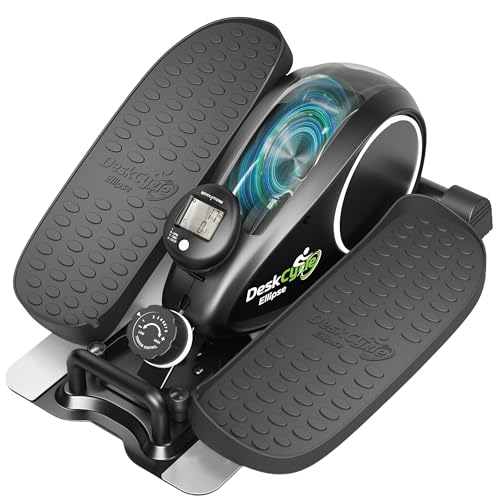
DeskCycle Ellipse
Best for: Using under a desk or table where knee room is tight
- Pedal height under 9 inches
- 8 magnetic levels, up to about 40 lb of resistance
- Rollers under the pedals keep it close to silent
See today's price, delivery options and owner reviews on Amazon.
Knee clearance is the most common problem with under-desk machines: your knees hit the desk on the upstroke. The DeskCycle Ellipse keeps its pedals lower than most and offers more resistance at the top, so it also works for people who want a harder workout. At about 30 lb it is heavier to move than the Cubii Go.
Pros
- Low pedal height for tight spaces
- Stronger top resistance than most under-desk models
Cons
- Heavier to carry
- No app connectivity
Best for arms and legs

Cubii Total Body
Best for: People who want to work the arms as well, without a full-size machine
- Under-desk elliptical with a built-in pulley system for the arms
- 12 resistance levels
- Designed for adults through seniors
See today's price, delivery options and owner reviews on Amazon.
Under-desk machines normally work only the legs. The Total Body adds cords you pull with your arms, so you can do some upper-body strength work from your chair. It sits between the small pedal units and the full-size FreeStep.
Pros
- Adds upper-body exercise
- More resistance levels than most under-desk models
Cons
- More to set up and learn than a simple pedal unit
Budget pick (sit or stand)

Stamina InMotion E1000
Best for: A low-cost machine you can also use standing, with support
- Use seated or standing
- Adjustable tension
- About 24 lb; listed 250 lb user limit
Currently unavailable on Amazon
Check availability on AmazonOut of stock right now. Amazon may list other sellers or a restock date.
The E1000 is one of the cheapest machines here, and one of the few made for standing use as well. Testers found it quiet at first, but some owners report squeaks over time, and the display is basic. Only use it standing if you can hold on to something solid.
Pros
- Low price
- Works seated or standing
Cons
- Can get noisier with time
- Basic display, lower user-weight limit
Motorized (moves your legs for you)
Best for very limited mobility

GUGTTR Electric Seated Pedal Exerciser
Best for: People who can't pedal on their own yet, such as during recovery
- Motorized auto mode, or a manual mode to pedal yourself
- Remote control, so there's no bending down
- Brushless motor described as low-noise
- Comes assembled
Currently unavailable on Amazon
Check availability on AmazonOut of stock right now. Amazon may list other sellers or a restock date.
A motorized pedal exerciser turns the pedals for you, gently moving the hips, knees and ankles. That suits people recovering from illness or surgery, or anyone who can't yet pedal against resistance. Switch to manual mode as your strength improves.
Passive movement is not a substitute for physical therapy. Ask your doctor or therapist how long and how fast to use it, especially after a joint replacement.
Pros
- Keeps legs moving even with little strength
- Remote avoids bending
Cons
- Not a real workout in auto mode
- Needs a power outlet nearby
Side-by-side comparison
| Machine | Type | User limit | Resistance | Set-up |
|---|---|---|---|---|
| Teeter FreeStep LT3 | Full-size, arms and legs | 300 lb, 4'11" to 6'6" | 13 levels | About 45 min, 2 people |
| Teeter FreeStep LT1 | Full-size, arms and legs | 300 lb, 4'11" to 6'6" | 13 levels | About 45 min, 2 people |
| Cubii Go | Under-chair, legs | Check listing | 8 levels | Minimal |
| Sunny Under Desk | Under-chair, legs | Check listing | 8 levels | None, arrives assembled |
| DeskCycle Ellipse | Under-chair, legs | Check listing | 8 levels (up to about 40 lb) | Minimal |
| Cubii Total Body | Under-chair, arms and legs | Check listing | 12 levels | Some |
| Stamina InMotion E1000 | Sit or stand, legs | 250 lb (listing) | Adjustable | Easy |
| GUGTTR Electric | Motorized, legs | Check listing | Motor speeds plus manual mode | None, arrives assembled |
“Check listing” means the maker doesn't clearly publish a figure we could confirm. If you weigh over 250 lb, check the Amazon listing or ask the seller before buying.
What a seated elliptical does for older adults
- Low-impact movement: your joints move through a full range without your body weight pounding through the knees and hips.
- Exercise without balance risk: you stay seated, which removes the fall risk of standing machines.
- Heart and lungs: steady pedalling raises your heart rate gently. A full-size cross trainer can give a proper cardio workout.
- Leg strength and stiffness: regular movement under light resistance helps keep the legs strong and the joints from stiffening, which supports everyday tasks like climbing stairs.
- Easy to fit into the day: under-desk models can be used while reading or watching TV, so short sessions add up.
Which type should you buy?
- Choose a full-size recumbent cross trainer if you want real cardio exercise, need back support, or want to work your arms too, and you have floor space of roughly 5 by 3 feet.
- Choose an under-desk elliptical if you mainly want to keep your legs moving while sitting, have little space, or need something you can lift and put away.
- Choose a motorized model if pedaling on your own is difficult right now. Many people move on to a manual model later.
Not sure an elliptical is right at all? Compare it with an under-desk bike or read about recumbent ellipticals for seniors.
Using a seated elliptical safely
- Use a sturdy chair without wheels, or lock the wheels. A rolling office chair can slide backwards when you push.
- Check the chair height. Your knees should stay slightly bent at the lowest point of the stroke and clear the desk or table at the top.
- Put the machine on a non-slip mat so it doesn't creep forward.
- Start low and short: about 10 minutes at the lowest resistance, then add a few minutes a week as it feels comfortable.
- Stop if you feel chest pain, dizziness, unusual shortness of breath or sharp joint pain, and speak with your doctor.
If you have heart disease, a joint replacement, balance problems or diabetes-related foot problems, check with your doctor or physical therapist before starting. See our health disclaimer.
Seated elliptical questions
Is a seated elliptical good exercise for seniors?
Yes, for most people. It gives low-impact movement for the hips, knees and ankles without the balance demands of standing machines. A full-size recumbent cross trainer can give a proper cardio workout. Under-desk models are gentler and better for staying active through the day.
Can I use an under-desk elliptical while watching TV?
Yes, and that's how most people use them. Choose a quiet magnetic model such as the Cubii Go or DeskCycle Ellipse, and use a chair that doesn't roll.
What's the difference between a seated elliptical and a recumbent bike?
A recumbent bike moves your feet in a circle. Seated ellipticals and steppers use an oval or stepping motion, which many people find easier on the knees. Full-size cross trainers like the FreeStep also work the arms. A recumbent bike is usually better if you only want leg cardio.
Will a seated elliptical help with circulation?
Moving your legs regularly instead of sitting still helps keep blood moving in the legs, which is one reason people use these machines during long periods of sitting. It is not a treatment for circulation conditions, so talk to your doctor if you have swelling, numbness or a history of blood clots. See also our guide to leg circulation machines.
How long should a senior use a seated elliptical each day?
Start with about 10 minutes and build up gradually. General U.S. guidance for older adults is around 150 minutes of moderate activity a week, which you can split into short sessions. Your doctor can tell you what's right for you.
Related guides
Popular on Amazon: seated & under-desk ellipticals
More dealsBest-selling items in this category on Amazon. We haven't reviewed all of them, so check the size, weight limit and return policy.


Keep reading

Fitness Equipment for Senior Living Communities: What to Buy
Updated Nov 10, 2026