Best Exercise Machines for People with Disabilities and Limited Mobility
We may earn a commission when you buy through links on this page. How that works
The short answer
For most people with limited mobility, the best home machine is a recumbent cross trainer with a swivel seat: you sit down from the side, turn to face the pedals, and work arms and legs together. The NuStep T4r is the clinic standard; the Inverapy RCT2025 brings a swivel seat and leg stabilizer to a lower price.
If you exercise from a wheelchair, an arm and leg pedal exerciser such as the MagneTrainer-ER works without any transfer. If your strength is very limited, a motorized pedaler can move your limbs for you.
 Best overall: the clinic standardNuStep T4r Recumbent Cross TrainerPeople who need the safest possible access and a machine built for years of daily use
 Best for one-sided weaknessInverapy by Innova RCT2025Stroke survivors and others with one weaker side, on a home budget
 Best for wheelchair usersDeskCycle MagneTrainer-ERArm and leg exercise from a wheelchair or a regular chair, with no transfer
Most home fitness equipment is designed for people who can step on, stand up and balance without help. If that isn't you, a standard elliptical or treadmill can be hard or unsafe to use. The good news is that there are machines built for exactly this situation, many of them the same ones used in physical therapy clinics. This guide covers which types work for which needs, the models worth buying, and what to check before you order.
Talk to your doctor or physical therapist first. They can tell you which movements are safe for your condition and how hard to work. This guide is general information, not medical advice.
Why regular exercise matters
The CDC recommends that adults, including adults with disabilities, aim for at least 150 minutes of aerobic activity a week, plus muscle-strengthening work such as resistance bands or adapted exercises. It also says that some activity is better than none, and that short sessions count. According to the CDC, fewer than half of U.S. adults with a mobility disability report doing aerobic activity, often because of barriers to walking and to getting to a gym. A machine at home removes many of those barriers.
Which type of machine fits your needs?
| Your situation | Best machine type | Why |
|---|---|---|
| Can transfer to a seat, but balance or stepping on is hard | Recumbent cross trainer with a swivel seat | Sit from the side, then swivel in; full-body workout while seated |
| One side weaker, for example after a stroke | Cross trainer with leg stabilizer and hand strap | Holds the weaker leg and hand in place while the strong side helps |
| Exercise from a wheelchair, without transferring | Arm and leg pedal exerciser | Sits on a table or the floor in front of your chair |
| Very limited strength or movement | Motorized (passive) pedal exerciser | The motor moves your arms or legs; add effort as you get stronger |
| Good balance, but sore knees or hips | Seated stepper such as the Teeter FreeStep | Low-impact, smooth motion, easy to start and stop |
Our picks
Best overall: the clinic standard
NuStep T4r Recumbent Cross Trainer
Best for: People who need the safest possible access and a machine built for years of daily use
- Seat swivels 360 degrees for side entry
- 400 lb user capacity
- 10 resistance levels, adjustable arm and leg positions
- Grab ring and stable foot pedals for support
Check the current price and any coupon on Amazon.
The NuStep is the machine you'll find in rehab clinics, cardiac rehab programs and senior centers, and the T4r is its version for homes and smaller facilities. You sit down from the side, swivel to face the pedals, and push and pull with arms and legs together. You never have to step over a frame or balance on a moving pedal, which is why therapists choose it for people who can't use standard machines.
It's expensive and heavy. For many people, especially those who need it for long-term rehab, the safe access is worth it. Ask your physical therapist whether your insurance or a local program can help with the cost.
Pros
- Easiest and safest access of any machine here
- Very high weight capacity and sturdy build
- Works arms and legs together
Cons
- Expensive
- Large and heavy
Best for one-sided weakness
Inverapy by Innova RCT2025
Best for: Stroke survivors and others with one weaker side, on a home budget
- Swivel seat and low step-through frame
- Leg stabilizer holds the weaker leg in place; wrist strap secures the weaker hand
- 16 levels of magnetic resistance
- 350 lb user capacity, with a safety stop system
See today's price, delivery options and owner reviews on Amazon.
The RCT2025 brings the NuStep's key access features, a swivel seat and leg support, to a much lower price. Its stabilizer system is designed for people with one affected side: it holds the weaker leg against the moving handle, and a strap keeps the weaker hand on the grip, so the stronger side can help drive the motion.
Check the listing for current warranty details, and have your therapist show you how to set the stabilizer for your body.
Pros
- Swivel seat at a home price
- Leg and hand support for one-sided weakness
Cons
- Less proven than the NuStep
- Warranty details vary by seller
Best for wheelchair users
DeskCycle MagneTrainer-ER
Best for: Arm and leg exercise from a wheelchair or a regular chair, with no transfer
- Use on a table as an arm bike, or on the floor for legs
- Smooth, quiet magnetic resistance with a fine-tune dial
- Adjustable Velcro foot straps
- Display shows time, speed, distance and calories
Check the current price and any coupon on Amazon.
A small pedal exerciser is the simplest way to get cardio without leaving your wheelchair. Put it on a sturdy table to pedal with your arms, or on the floor in front of your chair for your legs. The MagneTrainer is a favorite in physical therapy because its magnetic resistance is very smooth, which matters if your movement is limited or uneven.
On a hard floor, a wheeled chair can roll backward while you pedal with your legs. Lock the wheels, or put the pedaler against a wall or on a non-slip mat.
Pros
- No transfer needed
- Arms or legs, in one small unit
- Quiet and smooth
Cons
- A lighter workout than a full cross trainer
Best motorized option

PhysioPedal Arm and Leg Pedal Exerciser
Best for: People with very little strength or range of motion, such as early in rehab
- Motorized mode with 8 speeds moves your limbs for you
- Resistance mode with 8 levels as you get stronger
- Works for arms or legs
- Compact enough for home use
See today's price, delivery options and owner reviews on Amazon.
When you can't pedal on your own, a motorized pedaler keeps your joints moving and blood flowing. You rest your feet or hands on the pedals and the motor turns them at a slow, set speed. As you get stronger, you can switch to resistance mode and do the work yourself.
Start at the slowest speed, and stop if anything hurts. Ask your therapist how long and how fast to go.
Pros
- Passive exercise for very limited strength
- Grows with you, from motorized to resistance
Cons
- Not a substitute for active cardio once you can do it
Best for bad knees and hips

Teeter FreeStep LT3
Best for: People with good balance and joint pain who want a full-body seated workout
- Smooth, seated stepping motion
- 13 magnetic resistance levels
- Seat adjusts for height and depth
- No power cord needed
Currently unavailable on Amazon
Check availability on AmazonOut of stock right now. Amazon may list other sellers or a restock date.
The FreeStep uses a stepping motion similar to clinic machines, at a home price. It's very easy on the knees and hips. It has no swivel seat, so you need to step in from the front, which makes it a better fit for people with joint problems than for people who need help with transfers. Read our full LT3 review.
Pros
- Great value for a seated full-body trainer
- Smooth and joint-friendly
Cons
- No swivel seat
- Large footprint
Budget pick
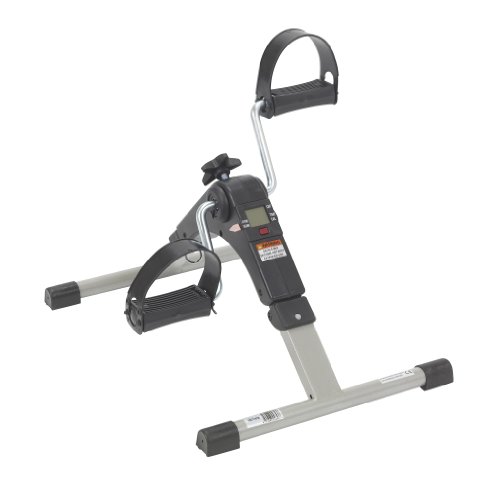
Drive Medical Folding Exercise Peddler
Best for: A simple, low-cost start to arm and leg exercise
- Arm or leg use
- Tension knob for resistance
- Display shows time, count, RPM and calories
- Folds for storage
Currently unavailable on Amazon
Check availability on AmazonOut of stock right now. Amazon may list other sellers or a restock date.
A basic, affordable pedaler from a well-known medical supply brand. Its friction resistance isn't as smooth as the MagneTrainer's, but it's a good way to find out whether pedaling suits you before spending more. Our pedal exerciser guide compares more models.
Pros
- Low price
- Light and folding
Cons
- Less smooth than magnetic models
- Can slide on hard floors
Accessible exercise machines compared
| Image | Product | Price |
|---|---|---|
| NuStep Recumbent Cross Trainer StepperComplete Low-Impact Workout for All Fitness Levels: This recumbent cross trainer mimics the movement of… | See price |
| Inverapy by Innova RCT2025 Recumbent Cross TrainerAssembly Required | See price |
| DeskCycle MagneTrainer Black Mini Exercise BikeConvenient: Stuck at home? Our peddler exerciser allows seniors and those with reduced mobility to get a… | See price |
| PhysioPedal® Premium Motorized Arm & Leg ExerciserVERSATILE UPPER & LOWER BODY TRAINING – QUICK-CHANGE DUAL-MODE DESIGN: Maximize your movement with one… | See price |
| Teeter FreeStep Recumbent Cross Trainer StepperLT3 PREMIUM FEATURES: Upgraded UltraGlide Bearings promise long-lasting frictionless motion for fluid start… | Check stock |
| Drive Medical RTL10273 Deluxe Folding Pedal ExerciserUnder Desk Bike Pedal Exerciser: The exercise peddler provides excellent low-impact exercise which is perfect… | Check stock |
What to check before you buy
- Getting on and off. This is the most important thing. Look for a swivel seat, a low step-through frame, and something solid to hold. If you use a wheelchair, measure the space you need to pull alongside the seat.
- Weight capacity. Pick a machine rated well above your weight. A higher rating usually means a sturdier, more stable frame.
- Straps and stabilizers. Foot straps keep feet on the pedals. Leg stabilizers and hand straps help if one side is weaker.
- Easy controls. Large buttons and a simple screen matter if you have limited hand strength or vision.
- Smooth, low starting resistance. Magnetic resistance starts gently and changes in small steps, which is better for building up slowly.
- Space and support. Leave room around the machine for a helper, and put it near a wall or sturdy furniture for support while you get on.
Safety tips
- Get your doctor's or therapist's approval, and ask them for a target time and effort level.
- Start with short sessions of 5 to 10 minutes and build up slowly.
- Have someone nearby for the first few sessions, especially while you learn to get on and off.
- Lock wheelchair brakes when you use a pedaler.
- Stop if you feel chest pain, dizziness, unusual shortness of breath or new joint pain.
Common questions
What is the best exercise machine for someone in a wheelchair?
An arm and leg pedal exerciser, such as the MagneTrainer-ER, is the simplest option because you don't have to leave your chair. If you can transfer, a recumbent cross trainer with a swivel seat, such as the NuStep T4r, gives a fuller workout.
Can stroke survivors use an elliptical?
A standard upright elliptical is often unsafe after a stroke because it needs balance. A seated cross trainer with a leg stabilizer and hand strap, such as the Inverapy RCT2025, is designed for one-sided weakness. Always follow your therapist's advice.
What is a recumbent cross trainer?
It's a seated machine where you push pedals with your legs and move handles with your arms at the same time. It gives a full-body, low-impact workout without the balance demands of standing machines. See our recumbent cross trainer guide.
Does Medicare pay for exercise equipment?
Generally, Original Medicare doesn't cover home exercise machines, because they aren't usually treated as medical equipment. Some Medicare Advantage plans, state programs and charities offer help. Ask your doctor, therapist or plan directly.
Are motorized pedal exercisers worth it?
For people with very limited strength or movement, yes. They keep joints moving and help circulation when you can't pedal yourself. Once you can pedal on your own, active exercise gives more benefit.
Related guides
Popular on Amazon: home gym
More dealsBest-selling items in this category on Amazon. We haven't reviewed all of them, so check the size, weight limit and return policy.



Keep reading
Fitness Equipment for Senior Living Communities: What to Buy
Updated Nov 10, 2026